September 17, 2016

What is the impact of Endospores on bacteria’s growth rate ?

That is the question I wanted to answer ! Not so easy … Because first of all, you have to know what an endospore is ! An endospore is a heat resistance structure that forms within certain cells. It allows some cells to survive under stress conditions ! 
Then, I had to choose only two bacteria, among all those that exist … Not an easy choice ! After some hard hours of thinking, I choose Bacillus subtilis, a beautiful little bacterium that has the superpower to grow spores and Escherichia coli, another wonderful bacterium not able to form spores. 

Now that I have my two protagonists, I have to be sure that some endospores form on B. subtilis. For that, I took some of those bacteria and decided to stain them, so that they become pink and the endospores become green. With colors, it is easier to distinguish the endospores ! Once I did the staining, I observe it under the microscope. What did I see !? Nothing … There was no green little thing … only pink bacteria … no endospores ! 

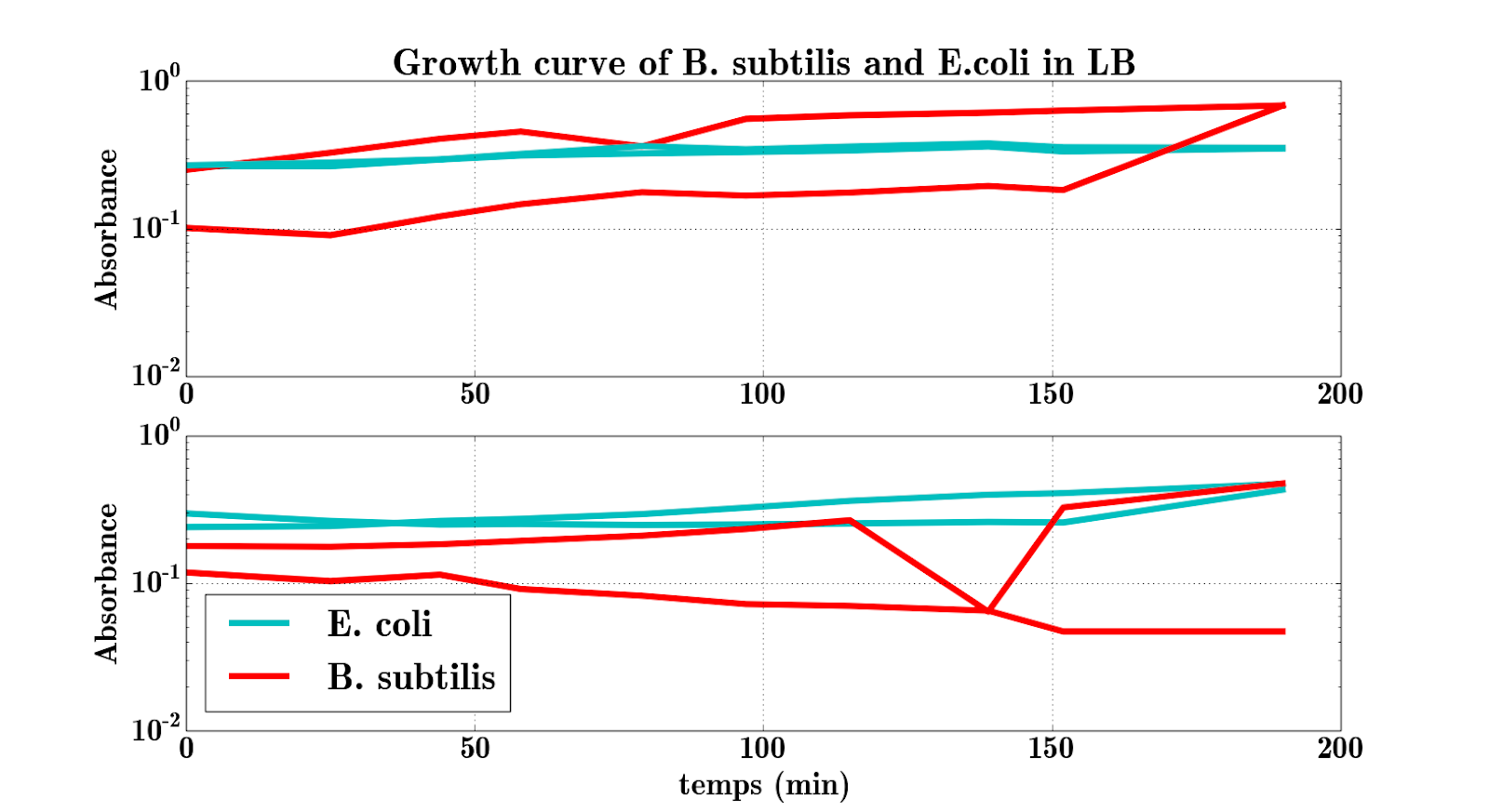
I was sad but I decided to move on : it’s not because there is no endospores that I cannot do my experiment ! Therefore, I did some overnight cultures : my bacteria could grow all night, and I will observe them in the morning. Then, when I woke up, I took a few amount of the overnight cultures to let them grow for another 6 hours in erlenmeyers, at 37°C, their optimum temperature to live, and 41°C, a higher temperature for them to stress and form endospores. After the 6 hours waiting, I measure the absorbance, with a spectrophotometer, to observe their growth rate. With my data, I manage to plot this graph : 
elena.png
First graph is at 37°C and the graph below is at 41°C
On this graph, nothing was happening like I thought it would … I saw that E. coli was growing at 41°C even though it should die and that B. subtilis was dying at 41°C even though it should be resistant. Everything was upside down ! Also, the growth rate was near to 0 while the bacteria were suppose to grow…

I still had to draw some conclusions. I think the bacteria are not growing because I had to let them grow for 6 hours in order to the endospores to form. Therefore, when I take my measures, they might already be in their stationary phase, which is why we cannot see any growth. I also had some material problems to put the bacteria at 41°C which could be the reason why E. coli are still growing at this temperature. Also I am not sure that the endospore form in B. subtilis, which could explain their die at 41°C. Maybe next time I should first be sure that endospores form, by stressing B. subtilis, by undernourishment.

If you want to know more, please take a look at the poster I did : https://docs.google.com/document/d/1Ju9UHWRhJi3lInW2Xy_V-iADRkeao3flViloPTj1NFU/edit

June 17, 2016

Make the Grand Gallery of Evolution evolve

Make the Grand Gallery of Evolution evolve
or how could the MNHN be improved


Paris’s museum of natural history is a historic place as well as a nice museum. Basically, its Grand Gallery of Evolution shows stuffed animals and gives some information about the species in a small text. Here is how I perceived it and how I would improve it.


                A museum made for children? Put more science in it!

To my mind, this museum was mostly thought for children. The first floor is the one with all the “cute” stuffed animals – a sort of zoo, but with dead animals. On the higher floors, where children may not always go because they are already tired with this huge first floor, there is more explanation on evolution and the objects exhibited are less visually impressive. Another argument in that sense is that the texts attached to the objects are short and simple. For example, we do not see the scientific name of the animals. Why forget the most accurate way to describe the presented object? Maybe because this is of no use for children who do not know what it refers to, they wouldn’t understand that Loxodonta Africana simply means elephant. Finally, there temporary exhibits clearly aims for an under 12 year-old public.


         Stop egocentricity: plants also evolve!

Another thing we can notice is that it almost only deals with animals. I do not remember of having seen any plant. Ok, it would be hard to stuff plants, but why isn’t this huge part of living organisms represented? They evolved at least as much as we did! At least if the museum was called the Grand Gallery fo Animal Evolution, I would have understood…


         Bring common ancestors back to life?

Now if I had to build a museum that shows evolution, I would insist on something that is not mentioned in this museum: the common ancestors. They are the key points to how today’s species are related, but they are not identified. Although scientific, a museum remains a place where you can show crazy ideas, so why not recreate common ancestors? It would be a way to visualize what the common ancestors to for example frog and gorilla could have looked like. Of course this is not a rigorous reconstitution, but isn’t doing hypothesis an important part of doing science? Plus, it would be a way to highlight evolutive adaptations (opposable thumbs, claws, backbone, etc).


All of this is of course strongly linked to my vision of evolution and what I find most fascinating in it. The same work of deciding what is to show was done when building this museum, and the choices made are not better nor worse than those I would have done – they just aim at something a bit different. One last thing: if you, English-reader of this blog post, want to visit this museum, make sure you can read a bit of French. None of the texts are translated…

Dara


Microorganisms can eat plastic, and it could save the Earth (or almost) - by Dara

Microorganisms can eat plastic, and it could save the Earth
(or almost)

A taste of Dara Nguyen & Paul-Henry’s review:


Each year, 250 million tons of plastic are produced but only 8% of it is recycled. A large part of it is released in nature, mostly in soils and in the oceans, thus highly disrupting ecosystems. In particular, the ingestion of small plastic fragments can cause wildlife cancers, and big fragments can lead to malformations (see picture below).


Plastics, that are polymers, are not easy to degrade because the strong bonds linking the monomers, which gives it interesting properties, are hard to break. Different methods exist, but it seems that there is no efficient and eco-friendly way to take care of these wastes. A new approach is being developed using the ability of some microorganisms to digest polymers.


What are these microorganisms?
What kind of plastics can they digest?


For this review, we did a bibliography of articles dealing with plastic-degrading microorganisms and tried to see the connections between them: how similar and different the mentioned microorganisms are, according to what criteria? What families of plastics are concerned? What can we deduce on the enzymatic mechanism implied? As we expected, we observed a large variety of species and polymers. We mainly focused on this diversity. Indeed, if several microorganisms can digest several polymers, it makes it a better weapon against the vast enemy that is plastic waste.


Our work could be summarized with the figure below. The most common classes of plastic polymers are represented with an example on the left. Microorganisms which can attack them are linked with a green dash. Else if we could not find any species that can deal with this class, it is followed by a red dash. As for the mechanism, they are not accurately identified and they are not the same for all species, so they do not appear on this figure. We can already see the diversity of polymer structure with their chemical formula; as for the microorganisms, you will find more details in the review and especially in the attached references (in brackets on the figure).


Our main conclusions are that plastic-digesting microorganisms can be bacteria or fungus, from any habitat, but they are all saprophytic – which seems obvious, saprophytic meaning that they can feed on non-living organic matter). As a consequence, they can attack several organic polymers although not all of them, but they have some trouble dealing with inorganic polymers. Maybe we could understand why some organisms and not others, why some plastics and not others, by better understanding the mechanisms. Studying and modeling this process could open the way to technologies that function the same and that we would control better.


If you want to know more…

TED talk: “Two young scientists break down plastics with bacteria
  
[1]           greenhome.com, 2016. The life of a plastic bottle [online]. Available at:
[2]           Moore, C. J., 2008. Synthetic polymer in the marine environment: A rapidly increasing, long-term threat. Environmental Research. 108, 131-139.     
[3]           Pathma, J., Sakthivel, N., 2012. Microbial diversity of vermicompost bacteria that exhibit useful agricultural traits and waste management potential. SpringerPlus. 1:26.
[4]           Stloukal, P., Pekarova, S., Kalendova, A., Mattausch, H., Laske, S., Holzer, C., Chitu, L., Bodner, S., Maier, G., Slouf, M., Koutny, M., 2015. Kinetics and mechanism of the biodegradation of PLA/clay nanocomposites during thermophilic phase of composting process. Waste Management. 42, 31–40.
[5]           Morét-Ferguson, S., Lavender, K., Proskurowski, G., Murphy, E. K., Peacock, E. E., Reddy, C. M., 2010. The size, mass, and composition of plastic debris in the western North Atlantic Ocean. Marine Pollution Bulletin. 60, 1873–1878.
[6]           Nakkabi, A., Sadiki, M., Ittobane, N., Ibnsouda Koraichi, S., Barkai, H., El Abed, S.,2015. Biodegradation of Poly(ester urethane)s by Bacillus subtilis. International Journal of Environmental Research. 9, 157-62.
[7]           Nakkabi, A., Sadiki, M., Koraichi Saad, I., Fahim, M., 2015. Biological degradation of polyurethane by a newly isolated wood bacterium. International Journal of Recent Advanced in Multidisciplinary Research. 2, 222-225.
[8]           Delafield, F. P., Doudoroff, M., Palleroni, N. J., Lusty, C. J., Contopoulos, R., 1965. Decomposition of poly-β-hydroxybutyrate by Pseudomonads. Journal of Bacteriology. 90, 1455-1466.
[9]           Yang, Y., Yang, J., Wu, W. M., Zhao, J., Song, Y., Gao, L., Yang, R., Jiang, L., 2015. Biodegradation and mineralization of polystyrene by plastic-eating mealworms: Part 2. Role of gut microorganisms. Environmental Science and Technology. 49, 12087-93.

[10]        Espinosa-Valdemar, R. M., Turpin-Marion, S., Delfin-Alcala, I., Vazquez-Morillas, A., 2011. Disposable diapers biodegradation by the fungus Pleurotus Ostreatus. Waste Management. 31, 1683-8.

[11]        Shinozaki, Y., Morita, T., Cao, X. H., Yoshida, S., Koitabashi, M., Watanabe, T., Suzuki, K, Sameshima-Yamashita, Y., Nakajima-Kambe, T., Fujii, T., Kitamoto, H. K., 2013. Biodegradable plastic-degrading enzyme from Pseudozyma antarctica: cloning, sequencing, and characterization. Applied Microbiology and Biotechnology. 97, 2951–2959.
[12]        Tsujiyama, S., Okada, A., 2013. Biodegradation of polyvinyl alcohol by a brown-rot fungus, Fomitopsis pinicola. Biotechnology Letters. 35, 1907-11.
[13]        Santo, M., Weitsman, R., Sivan, A., 2013. The role of the copper-binding enzyme – laccase – in the biodegradation of polyethylene by the actinomycete Rhodococcus ruber. International Biodeterioration & Biodegradation. 84, 204-210.
[14]        Mohan, A. J., Sekhar, V. C., Bhaskar, T., Nampoothiri, K. M., In press. Microbial assisted High Impact Polystyrene (HIPS) degradation. Bioresource Technology.

[15]        Ishigaki, T., Sugano, W., Ike, M., Kawagoshi, Y., Fukunaga, I., Fujita, M., 2000. Abundance of polymers degrading microorganisms in a sea-based solid waste disposal site. Journal of Basic Microbiology. 40, 177-186.

Blog disclaimer

The content created by the Learning thru research Student Bloggers and those providing comments are theirs alone, and do not reflect the opinions of Centre de recherche interdisciplinaire, University Paris Descartes or any employee thereof. The authors of posts and comments are responsible for the accuracy of any of the information supplied on this blog, as well as for any content copyright issues.