January 25, 2017

Who sees the most ?
Lentils Vs TCS3200
By Nina Guérin, Lara Narbona Sabaté and Adrien Vergès


During one week, our team worked on lentils. The reason? Testing which colors could be sensed by lentils in comparison to a traditional RGB (Red Blue Green) sensor TCS 3200.
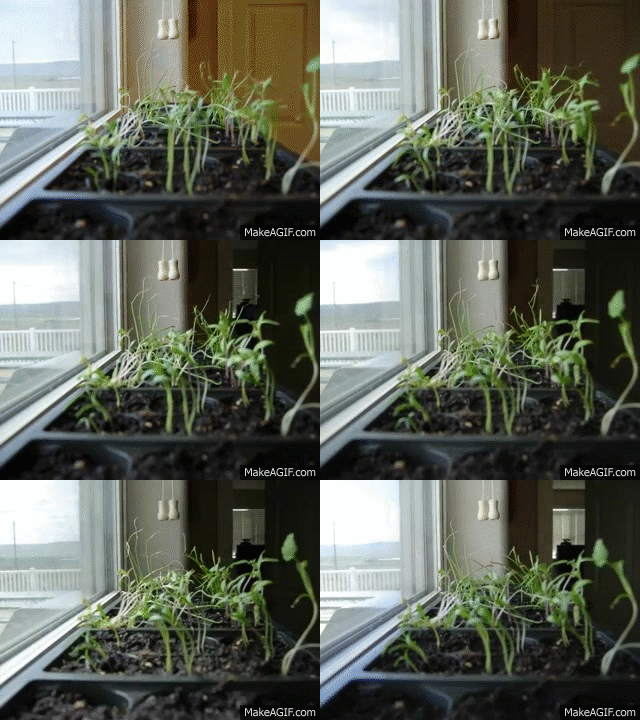
RIX3Hk.gif
Light has a major role in life on Earth: it helps plants to do photosynthesis, it helps us to get vitamin D, it warms Earth enough to allow life...
Light is a wave. The change of its wavelength (the distance between tops of this wave) changes also the color of light. The colors of visible light (as in a rainbow) go from violet (wavelength around 400 nm) to red (wavelength around 800 nm), characterising the visible domain of light.
But light does not refer only to the visible spectrum. There are also other domains of light non-visible by our eyes such the ultraviolet (UV) or infrared (IR).
Wavelength is one of the characteristic used to define a light, but not the only one. We can also precise its intensity, if it is polarised or not, … On our experiment we focused on the wavelength (also known as the color) of light.


We asked ourselves which spectrum of light is perceived by plants, and if a common RGB sensor had a wider range of perception. This is why we decided to compare lentils to a electronical sensor, TCS3200 color sensor. In this experiment, lentils are considered as a biological sensor: an organism (or a part of it) that, with its behaviour, can help to measure different phenomena. For its part, an electronic sensor can also help to measure different phenomena but would be made all by electronical devices.


But… how can lentils actually help in measurements?
Lentils (Lens culinaris) are a type of plants easy to grow and find. The growth of their sprouts, once they are germinated, is quite fast (in 18h they can grow for 2cm according to our experiences).
As all plants, they also do photosynthesis: they use light as a source of energy to their metabolism and therefore to grow. That’s why, when they’ll be exposed to certain light wavelengths, they will grow faster.
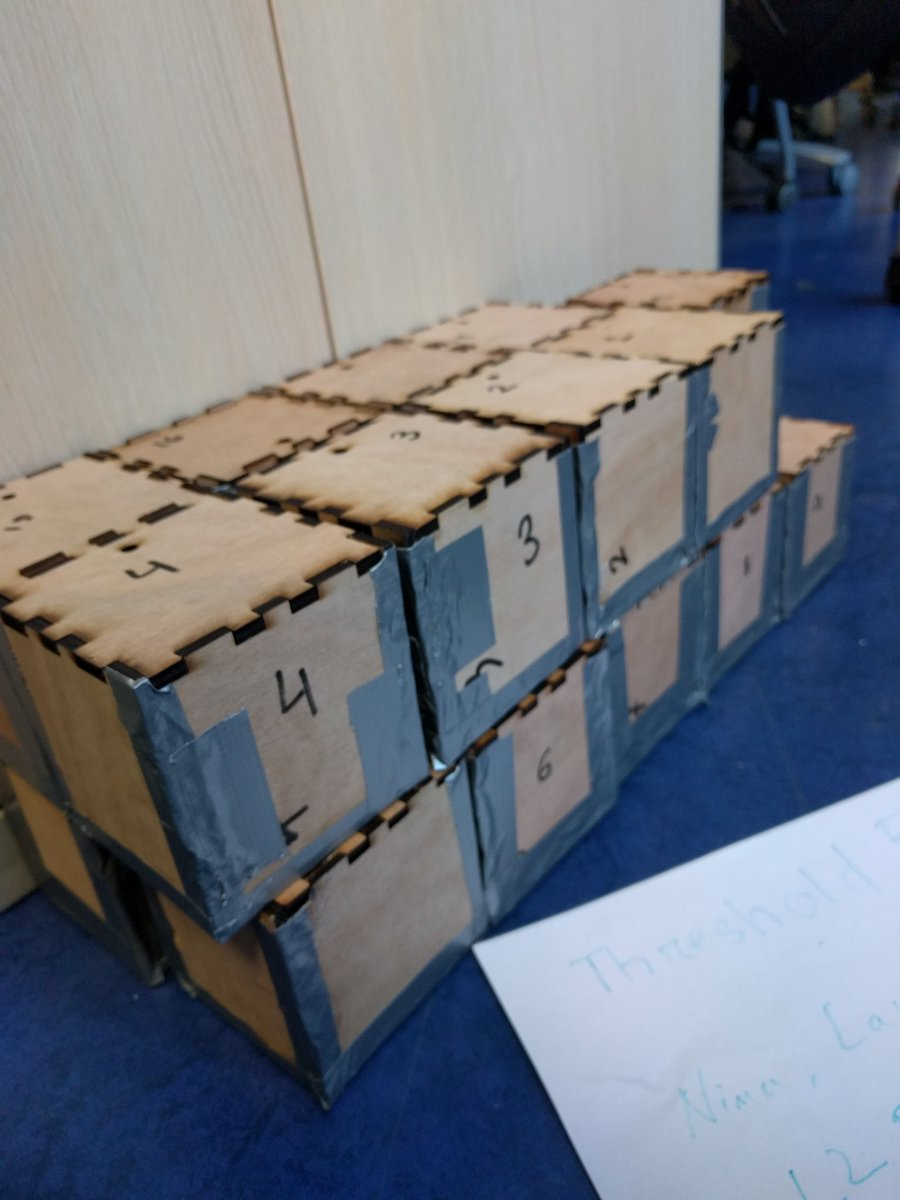

Fig 1. Boxes used for the protocol


And the RGB sensor?


A lot of different light sensors exist. They can measure the intensity of light or its color. Since we wanted to know which wavelengths did a common sensor detect, we decided to use the TCS3200 color sensor. Powered by an Arduino, this sensor gives RGB value of the object in front of it captor.


Our experiment
We used 19 boxes (figure 1) in order to isolate lentils from exterior light : we tested 5 different light wavelengths (infrared, red, green, blue and ultraviolet) and for each color, we did 3 replicates. Moreover, we did 2 positive controls (boxes exposed to sunlight, to see what was lentils normal growth rate)  and 2 negative controls (boxes kept in the dark, to see what was their minimal growth rate).


We measured how much did the sprouts grow in 18 hours depending on its exposition to light. That could help us to know with which intensity (% of reception) does lentils respond to light.


Data analysing
Fig 2. Intensity of the biological captor
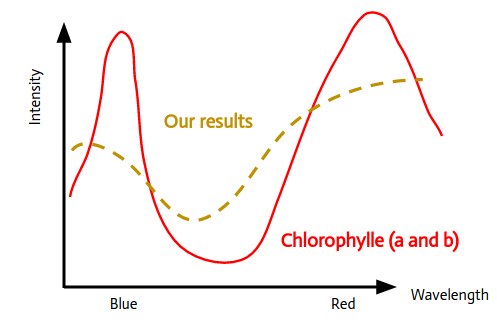

On figure 2 we can see the trend curve of our results in yellow and chlorophyll reception of light in red. Our results show that lentils grow better under red and IR light. The lowest growth rate occurs under green light.
Those results shows that lentils grow better under red and blue light; as Engelmann’s experience showed (1886). What we can also see is that lentils can sense UV and IR wavelengths (since their growth on those domains was greater than the one of the negative control).
The question is : is the sensor TCS3200 better on detecting those wavelengths? To answer that question, we collected the values given by the electrical sensor when put in the same conditions as lentils (figure 3).
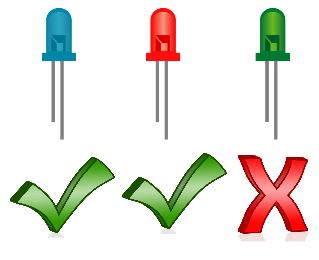
Fig 3. Percentage of red, blue and green detected under red and blue light.
The results showed above were obtained with red and blue LEDs. Green was not recognised by the sensor: indeed, the sensor recognized green color as sunlight.
result-elec-sensor.png


Conclusion


Comparing the biological data and the electrical data does not make any sense. At the beginning we expected to compare both sensors but we realised that data do not allow to do so. Because sensor’s data underline its lack of precision and prevent us to quantify the intensity of its values. Anyway, we managed to understand that lentils grows faster under red and blue light, and that color sensor TCS3200 cannot perceive the green light nor UV or IR.
If you want to know more:


Do not hesitate to check this video in order to see what is phototaxis and this video in order to learn more about Engelmann experiment.
If you want to know more about light polarisation
If you want to know how does RGB work.
If you are interested in our storify : Storify
If you want to have an access to our sources and more :Notre github

January 24, 2017

BioLumos

BioLumos

 eye2.png

Living beings can interact with their environment. Some are sensible to different stimuli : for example, human beings can perceive light with their eyes. We, humans, also build tools to detect and measure different stimuli, for example light sensors (like cameras). During a week, we compared the characteristics of the human eye and of a RGB sensor, and we were trying to see how well are they able to perceive the difference between two colors.


In the human eye, the perception of different colors is possible thanks to the cones located in the retina. There is three kind of cones and each one of them is sensitive to one of these three fundamental colors : red, green and blue, which are enough for the human brain to have the sensation of all the colors. You can learn more about the human eye perception of colors through this very well explained TedEd video.
A RGB sensor is an electronic sensor that can distinguish colors. It contain photoreceptors for the same three fundamental colors (red, green and blue) and can make an average of those three colors depending on the environment.


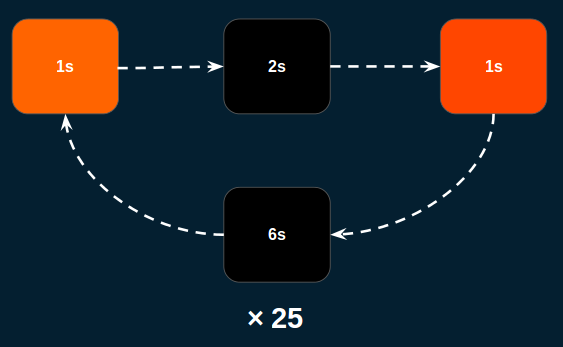
In order to see how humans could perceive the difference between two colors, we took four slightly different oranges, similar but not identical, differing in the proportion of green pixels components. We randomly formed pairs with these oranges : The two oranges could be identical, slightly different, quite different or very different. The subject was is introduced in a dark room and had to sit on a chair facing a computer screen that displayed the following pattern of screens : 1s, 2s of black screen, 1s of second orange. This pattern was followed by 6s of black screen during which the subject was supposed to say if he perceived the two oranges as “same” or “different”. (Figure 1)

1.png
Figure 1 : The pattern of the video showed to human subjects


Believe me, the experiment was quite hard for the subject. We also showed the RGB sensor those four oranges to see if it could distinguish them. The whole documentation describing the experiments thoroughly, along with the data and scripts, can be found on Github.


The human subjects gave 66% of good answers, which is not a lot if you consider that 50% of these answer corresponds to “subjects answered randomly”. However, people contradicted themselves a lot : when facing twice the same pairs, they often gave opposite answers, like “same” the first time and “different” the second. On the total of 800 answers we had, 357 were contradictions ! (Figure 2). The RGB sensor detected the colors but didn’t noticed the difference between them.
Figure 2 : A global view on the answers given by human subjects


So, what are the differences and the similarities between electronic and biological sensors ? They are both sensible to red, green and blue. However, RGB sensors are very sensible to the distance to the object. Eyes are able to see pretty much the same within a few meters radius, while the sensor work very bad further away than 50 centimeters or so. Furthermore, the human eyes is not digital, meaning it does not give a numerical value associated with a color. RGB sensors are calibrated, they are able to associate a color with a number, which humans can not do. This is why we used comparison for humans (“Are those oranges different ?”) rather than asking a description, which is very hard for us. By the way, you could try to experiment on this : try to describe a color, only with human-readable words (no digits or diagrams) and tweet it to @bio_lumos. We’ll share the best ones !

Moreover, to be able to distinguish color isn’t only due to biological perception but also from social factors. For example, a researcher realized that color perception was also depending  on your own language. See more in the following article : “Özgen, Emre. "Language, learning
If you want to know more about the way we proceeded, our data collected or our coding elements, go on our GitHub page. During this project we used Tweeter to inform people about our daily adventure that we resumed in this storify ! Hope you'll enjoy learning more about our project ! ;)

© Lina Vigneron, Armelle Supervie, Samuel Churlaud

January 23, 2017

Shining Shrimps Project

Shining shrimps project
January 22th, 2017
Blink, blink, blink
Helloooooo everyone !
As a part of Biosensors, a challenge of four weeks to make amazing projects about organisms and their sensors, we had the opportunity to work about the light and its relationship with organisms. First, you should know that light plays an important role for the most of organisms, whether they live on earth or in water.bloggif_5885033daf99e.gif
Artemia salina - little brine shrimps living in lakes, usually food for fishes, are attracted by light and swim in its direction but also, could be repelled by it depending on moments (see a video demonstration here). More, this species possess three eyes with one special to detect light and its direction! This is why we asked ourselves this question:

How Artemia salina are sensible to light in comparison of an electronic sensor ?

First, to respond to this question, we tried to focus on different aspects of the Artemia salina movement to the light. We chose to observe their light intensity sensibility, which means how much Artemia salina can perceive light, and the time that they need to react.
Usually, new technologies invented by humans are inspired from nature, biological systems which already exist. Make comparisons could allow to improve our inventions. Our objective was to use an electronic sensor to see which one between shrimps and an electronic device is the best performer to detect light!
To decide between them, we tested them on four different luminosities (low, medium-low, medium-high, high). They would be plunged into the black, then exposed to a specific luminosity to observe their reaction, response time, as we told previously.
To realize our project, we followed this scientific approach:

Get samples > Preliminary tests > Realization of the set up > Experiments and replicates > Analyze raw data > Conclusion

To preserve the Artemia salina bought in an aquatic organisms shop, we prepared a salt water made home with love, by mixing 450 g of salt and 15 liters of water at 10°C in a big tray, then adding three drops of nutrients solution (Plankton liquid, you should try this is really tasty!).
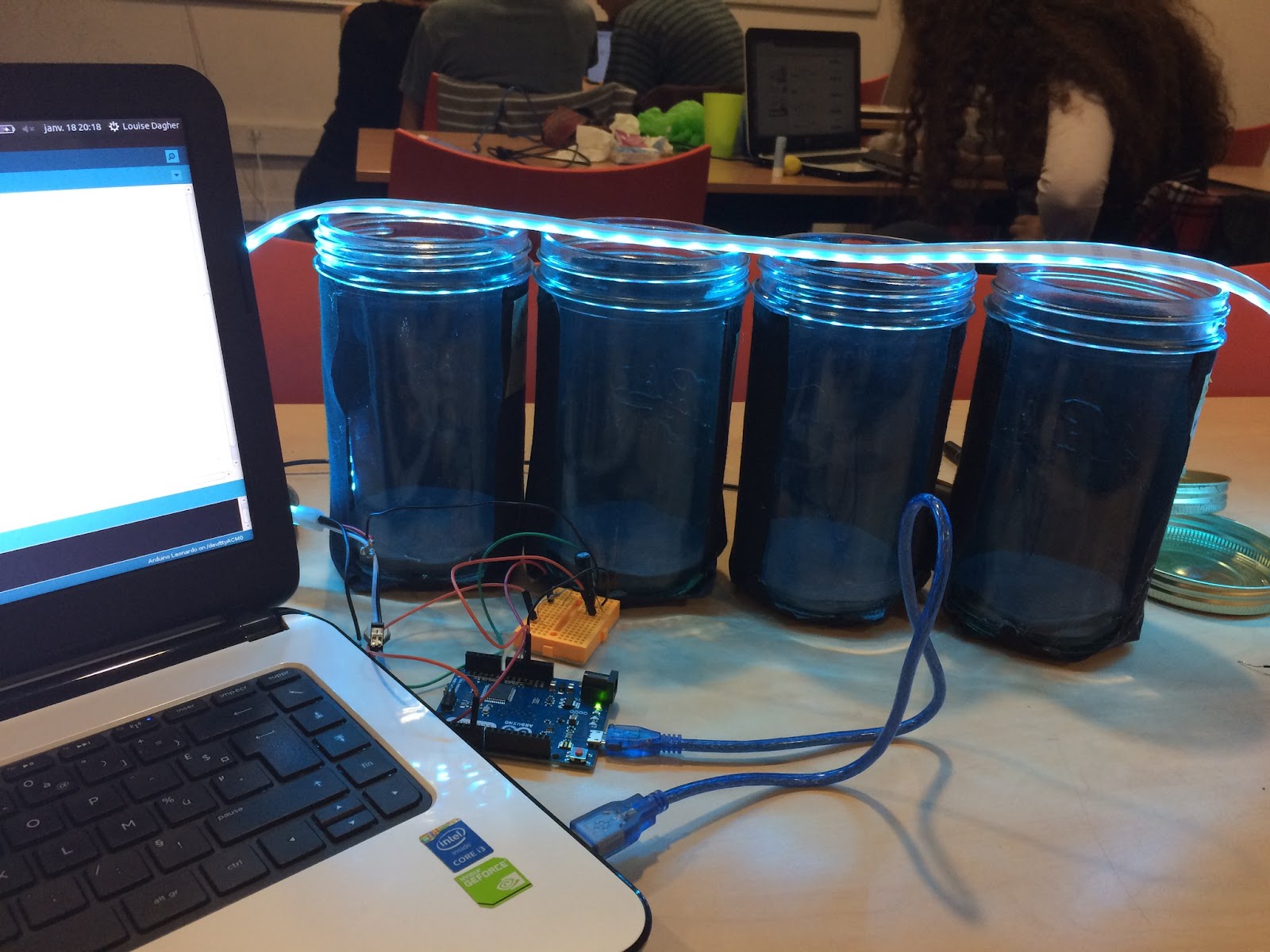
The day before, we customized three jars of 1 L with black sheet to serve as small aquariums for the experiments. Why three ? Because to prove an hypothesis, you need to multiplicate your experiment to ensure the entire world that many similar results confirm your hypothesis. We call it replicate. Then, we also realized the setup to provide the light source: we used a LED strip with an Arduino Leonardo, which is actually an electronic device which could be managed by a computer and could sense/control objects in the physical world. You can admire our setup on the GIF below. With the same way, we made the electronic sensor.
Image 1.jpeg
After this step, we began the experiments by putting shrimps into the black, then lighting and filming them. We did the same conditions with the electronic sensor.
gifsetup.gif
By using the Tracker Software, we recorded the shrimps trajectory, frame by frame, and compared their position with the y axis, in order to know if the light wera attracting them, repulsing them, or either having no influence on them.
It was an exhaustive work, so we didn’t tracked the whole 7min of film, but only the first minutes, which represent almost 30 points, per shrimp.


Capture du 2017-01-23 20-11-57.png
As results, we found that under a certain luminosity (~ 150 lux) the shrimps were repelled by the light, going down to the bottom of the jar ! This phenomenon exists and is called negative phototaxis.   This is the same phenomenon as bats who do not like the light of the day. In contrary, they are attracted when light is over 240 lux. As explanation, we can suppose that these both phenomenons give an advantage to Artemia salina shrimps to better survive, such as to find food or anything else.
On the other hand, our range of 4 luminosities was too short to determine the sensibility of the electronic sensor. We saw that it response time is always the same whatever is the luminosity.
To put it in a nutshell dear readers, we have seen that Artemia salina is attracted to certain intensities of light and repulsed by the lowests. But what about higher intensities ? We let you discover that by yourself !
Furthermore, if you want more information and learn about scientific experiments made about it, you can consult this article !
And here is our Storify !
GitHub link here to all the resources needed for this project.
Presentation link here.
And if you want to know more about us and our project, you can visit/follow these Twitter pages : Louise, Nicolas, Clément,  The Artemia salina project page, Biosensors page

Blog disclaimer

The content created by the Learning thru research Student Bloggers and those providing comments are theirs alone, and do not reflect the opinions of Centre de recherche interdisciplinaire, University Paris Descartes or any employee thereof. The authors of posts and comments are responsible for the accuracy of any of the information supplied on this blog, as well as for any content copyright issues.